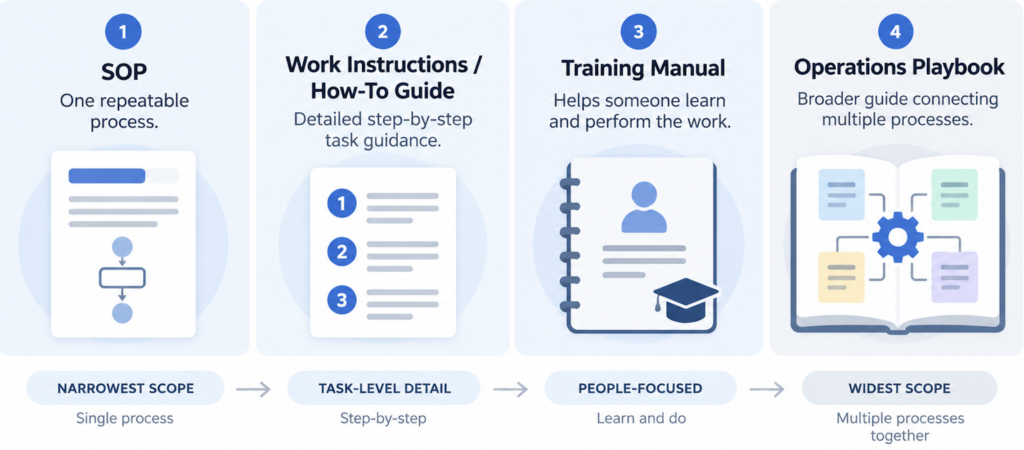
SOP vs. Work Instructions vs. Training Manual vs. Operations Playbook: What’s the Difference?
September 24, 2026Sometimes a business knows exactly what it needs documented.
There is a process that lives in someone’s head, causes confusion, or simply needs to be captured clearly so someone else can follow it.
Other times, the need is much bigger.
Maybe several processes are undocumented. Maybe different departments depend on one another, but no one has ever stepped back to look at how the work connects. Or maybe the real issue is not just documentation — it is understanding how the business operates as a whole.
Those are two very different types of projects.
That is why 4Chord offers two different approaches: SOPs on a Budget and SOP by Design.
When SOPs on a Budget Makes Sense
SOPs on a Budget is designed for businesses that need one specific, repeatable process documented clearly from start to finish.
You already know the process you want to capture. The scope is focused.
We are not trying to document an entire department or figure out how multiple areas of the business work together. The goal is simply to take one process and turn it into a clear, usable SOP.
For many small businesses, that is exactly what they need.
Examples might include:
- Processing a customer refund
- Qualifying an incoming sales lead
- Approving a PTO request
- Receiving and routing a customer request
- Completing one repeatable administrative workflow
The process is already understood. It simply needs to be captured clearly so someone else can follow it.
When the Need Is Bigger Than One SOP
Sometimes you start with one process and quickly realize the issue goes much further.
Maybe the process crosses several departments.
Maybe different people own different pieces of the work.
Maybe there are multiple handoffs, overlapping responsibilities, or processes that have never been clearly defined.
That is where SOP by Design can make more sense.
SOP by Design is a more hands-on, project-based engagement. It may include interviews, shadowing, screen sharing, and conversations with different process owners.
The goal is not simply to document what happens. It is to understand how the work moves through the business, where the pieces connect, and what documentation is actually needed to support it.
Learn more about SOP Design & Documentation.
Start With the Scope
If you are not sure whether you have one process or several connected processes, start by defining where the work begins and ends.
As we covered in What Counts as One Process for an SOP?, a focused SOP should cover one repeatable process with a clear starting point, defined actions, and a clear ending or outcome.
If what you are trying to document keeps expanding into multiple teams, responsibilities, or connected workflows, that may be a sign that you need something broader than one SOP.
A Simple Way to Think About the Difference
If your question is:
“Can you help us document this one process?”
SOPs on a Budget may be the right fit.
If your question is closer to:
“Can you help us figure out and document how all of this works?”
You are probably looking at a larger SOP by Design project.
Neither option is better than the other.
They are simply built for different needs.
SOPs on a Budget is designed to capture one process well.
SOP by Design is designed to understand the bigger picture and build the documentation around it.
The right solution starts with getting the scope right.
Not Sure Which One Fits?
If you already have one clear, repeatable process in mind, explore SOPs on a Budget.
If the need involves multiple processes, teams, or areas of the business, learn more about SOP Design & Documentation.
If you are still not sure, 4Chord can help you determine the right starting point.