What Is an SOP? A Simple Guide for Small Businesses
September 9, 2026
What Makes an SOP Effective? 5 Outcomes to Look For
September 21, 2026When we talk with business owners about Standard Operating Procedures, one of the first questions that comes up is surprisingly simple:
What actually counts as one process?
It sounds obvious until you start trying to define it.
Someone may say, “I need an SOP for HR,” or “We need to document Sales.”
The problem is that HR or Sales are not individual processes. They are broad business functions made up of smaller areas that contain individual, repeatable processes.
That distinction matters.
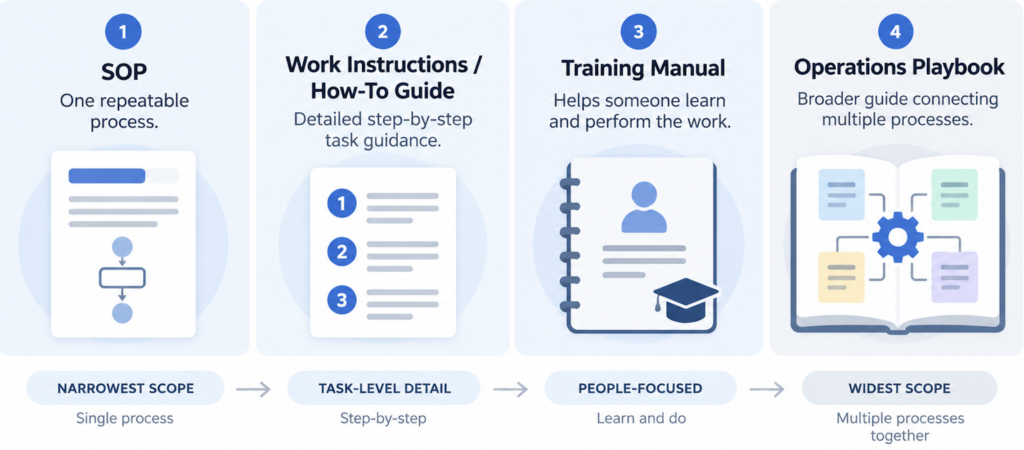
As we covered in our guide to what an SOP is and why it matters, a useful SOP should focus on one specific, repeatable process from start to finish.
If you try to capture too much in one document, you usually end up with something long, complicated, and difficult for anyone to actually use.
Start Broad, Then Narrow It Down
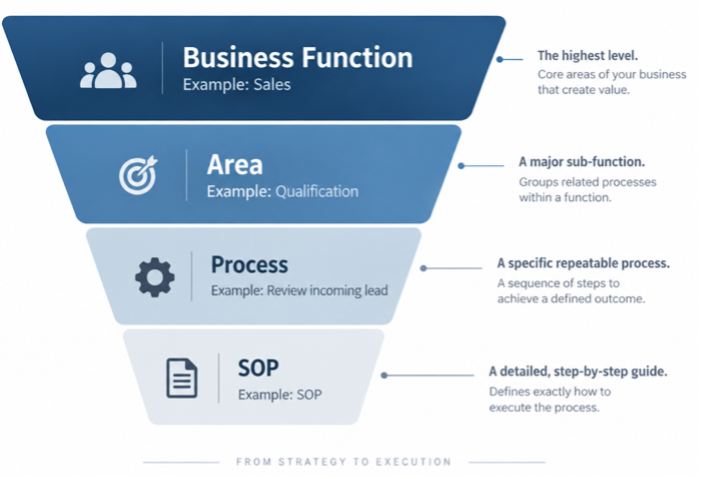
Think about your business in layers.
Human Resources might include recruitment, payroll, benefits, and leave. Sales might include prospecting, qualification, discovery, and closing. Customer Service might include receiving customer requests, order issues, credits and refunds, and escalations.
But even those areas may contain more than one process.
For example, Sales Qualification could include a repeatable process for reviewing an incoming lead, determining whether it meets specific criteria, recording the information, and deciding what happens next.
Now we are getting closer to something that makes sense as an individual SOP.
What Does One Process Look Like?
A good way to test the scope is to ask whether the process has:
- A clear starting point
- A defined set of actions
- A clear ending or outcome
- Steps that can be repeated consistently
If you cannot tell where the process begins and ends, there is a good chance you are still looking at something too broad.
For example:
Too broad: Manage the sales cycle
Better: Qualify an incoming sales lead
Too broad: Manage Customer Service
Better: Receive and route a customer request
The goal is not to squeeze an entire function or workflow into one document. The goal is to identify the smaller processes inside it and document those clearly.
Want to see what that looks like as a finished SOP? Download our free sample SOP, which documents a fictional customer-request intake and routing process from start to finish.
So, When Is a Process Too Big for One SOP?

Here is a rule of thumb we use:
If the person who knows the process best needs more than about 30 minutes to describe it from start to finish, you may actually be dealing with more than one process.
That does not mean there is anything wrong with the process. It may simply mean it needs to be broken down.
Take employee onboarding as an example. Someone may initially say:
“I need an SOP for onboarding a new employee.”
But once they start walking through everything involved, they may mention:
- Creating the employee record
- Setting up payroll
- Enrolling the employee in benefits
- Assigning system access
- Completing required paperwork
- Scheduling training
At that point, employee onboarding is probably not one process. It is a broader workflow made up of several smaller processes, and several of those may need their own SOP.
The 30-minute guideline is not a hard-and-fast rule. Some processes need more explanation than others, and every business is different.
The point is to help you recognize when the scope is getting too large.
If your documentation needs extend across several connected processes or departments, read When One SOP Is Enough and When You Need More to see when a larger engagement may make more sense.
Why Getting the Scope Right Matters
A good SOP should make work easier to follow.
When too many processes are recorded in one document, the opposite happens. The SOP becomes long, overwhelming, and harder to maintain.
Keeping the scope focused makes documentation easier to understand, easier to update, and more useful to the people actually doing the work.
It also helps you decide what business knowledge is most important to capture first.
Try asking:
“What is one repeatable process we need someone else to be able to perform consistently?”
That question usually gets you much closer to the right starting point.
For SOPs on a Budget, that is exactly the goal: identify one specific, repeatable process and document it clearly.
Start with one.
Get the scope right.
Then build from there.
Have One Process in Mind?
SOPs on a Budget is designed specifically for documenting one clear, repeatable process at a time—without requiring a larger process-documentation engagement.