What Counts as One Process for an SOP? How to Know If Yours Is Too Big
September 16, 2026
What Happens When Critical Knowledge Lives With One Person?
September 21, 2026In our first article, we covered what an SOP is and why documenting a repeatable process matters. But simply having an SOP does not automatically make it useful.
A good SOP should make the work easier, clearer, and more consistent. It should help someone understand what needs to happen, who is responsible, and how the process should be completed – without relying on one person to explain it every time.
So how do you know if an SOP is actually doing its job? Here are five outcomes to look for.
1. More Consistent Results
When a process is not clearly documented, people may approach the same work in different ways. Over time, that can lead to missed steps, inconsistent results, and confusion about what the process is supposed to look like.
An effective SOP gives everyone the same starting point. It should answer a simple question: How is this process supposed to be done?
That does not mean there can never be flexibility. It means the core process is clear enough that people are working from the same foundation and important steps are less likely to be missed.
2. Less Reliance on One Person
This is one of the biggest reasons process documentation matters, especially in a small business.
What happens if the person who normally handles a critical process goes on vacation, changes roles, retires, or suddenly is not available? Would someone else know what to do?
A good SOP captures that knowledge before the business needs it. The goal is not to replace experience or judgment. It is to make sure an important process does not stop simply because the person who usually owns it is unavailable.
3. Clearer Ownership and Handoffs
Many processes do not stay with one person from beginning to end. Work gets passed from one person to another, or from one department to the next. Those handoffs are often where things fall through the cracks.
An effective SOP should make it easier to understand who is responsible, what needs to happen next, and when the process is complete.
When ownership and handoffs are clear, there is less guessing, less duplicated work, and less chance that something gets lost between people or teams.
4. Fewer Errors and Less Rework
When people are relying on memory, verbal instructions, or their own interpretation of a process, small differences can turn into mistakes and rework.
A useful SOP creates a consistent reference point for the steps that matter most. It can help identify required information, decision points, quality checks, and common exceptions before they become problems.
The goal is not to eliminate every possible mistake. It is to reduce avoidable ones by making the expected process easier to follow.
5. Faster, More Effective Training
A well-written SOP should do more than satisfy a compliance requirement or check a box. It should be something employees can actually use to learn and perform the process.
That makes an SOP a practical training tool. New employees have a clear reference as they learn, existing employees can check the process when questions come up, and managers do not have to repeatedly explain the same steps from scratch.
Good documentation does not replace hands-on training when training is needed. It supports it by giving employees something reliable to return to after the conversation or demonstration is over.
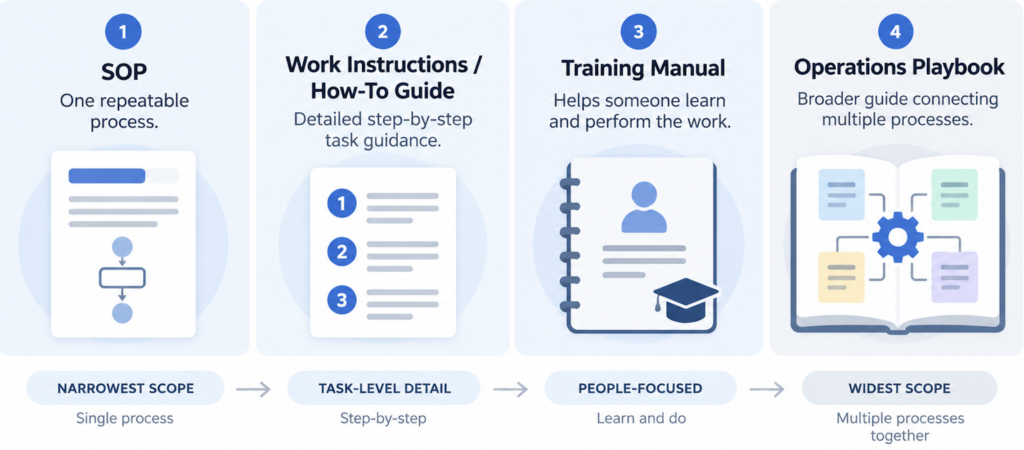
A quick note on scope: as we discussed in our last article, an SOP works best when it focuses on one specific, repeatable process. If the document is trying to cover several different processes at once, it becomes harder to understand, maintain, and use consistently.
The Real Value Is What the SOP Makes Easier
The real value of an SOP is not the document itself. It is what becomes easier because the process is documented: training, delegation, consistency, coverage, and day-to-day execution.
A good SOP should help the business rely less on memory and more on a process the team can actually follow.
For SOPs on a Budget, that is the goal: take one important, repeatable process and capture it clearly enough that someone else can understand it and use it.
Have One Process That Needs to Be Documented Clearly?
SOPs on a Budget is designed to turn one clearly defined process into a professional, usable SOP without requiring a larger process-documentation engagement.